
Rock Beats Paper
Why Even the “Good Silver ETF” Isn’t Safe

📣 Enjoying this?
Tap below to share it with a friend who holds investments in Silver ETfs:
For years, PSLV… Sprott’s Physical Silver Trust… has been the darling of silver stackers. It was marketed as the honest ETF. Fully backed, redeemable for physical, and outside the reach of Wall Street’s paper games.
But the numbers tell a different story.
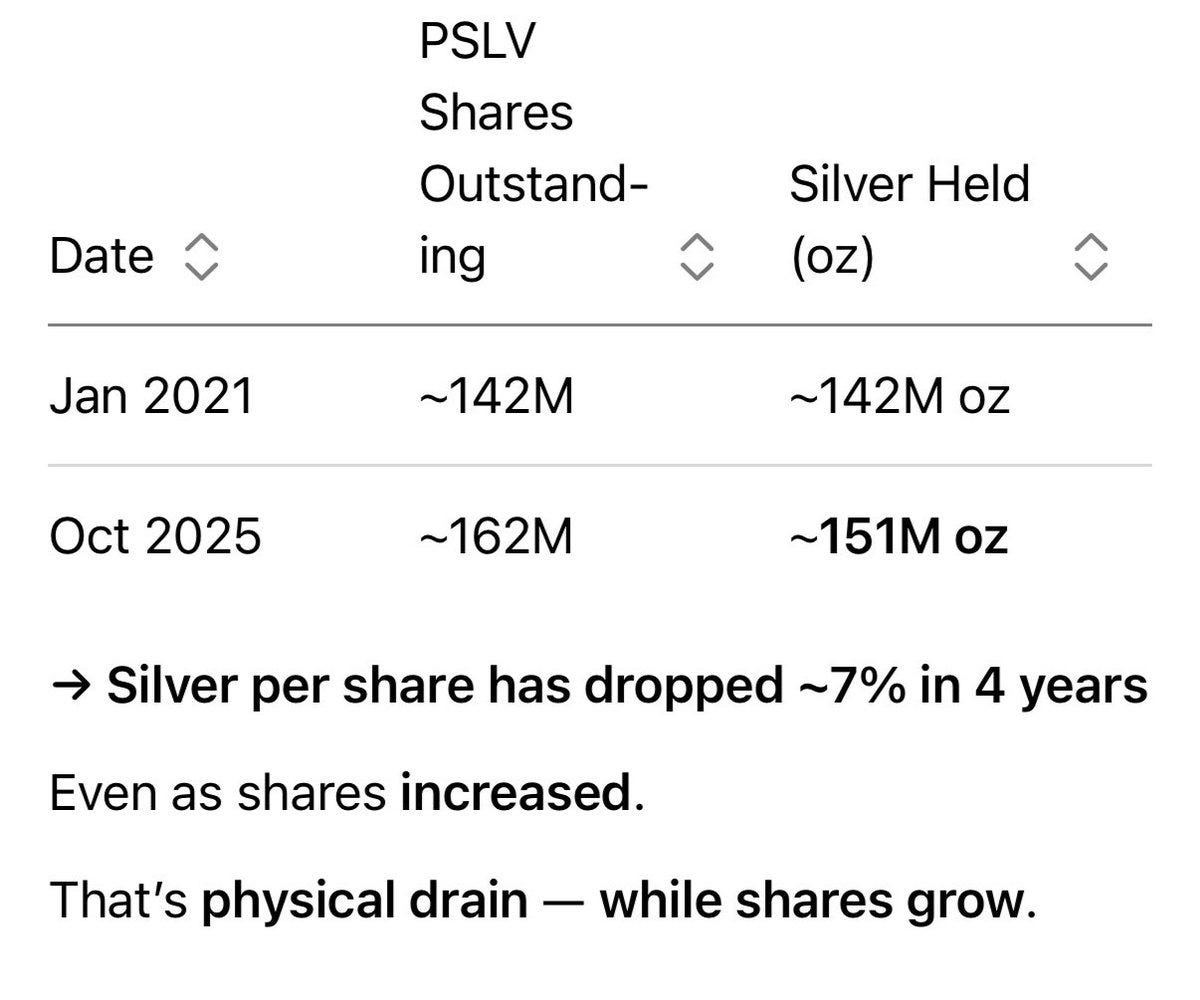
In early 2021, PSLV reported roughly 142 million shares outstanding and 142 million ounces of silver held… a one-to-one match.
By October 2025, it listed 162 million shares but only 151 million ounces of metal.
That’s a 7% drop in silver per share… even as shares increased.
The Subtle Drain
Most investors assume “fully backed” means each share represents a real ounce of silver sitting in a vault. But ETFs are built around a mechanism that lets Authorized Participants (APs)… big banks and market makers… create and redeem shares.
That’s where the game is played.
AP borrows ETF shares or creates new ones.
They sell those shares short into the market.
The proceeds buy existing shares, which they redeem for physical silver.
Result? Metal leaves the vault, while retail investors are left holding paper claims on a shrinking pile of real metal.
Perfectly legal. Almost invisible. Entirely systemic.
The JPM Example… Explained Like You’re 5
A recent post by Silver Haas laid this out with brutal simplicity:
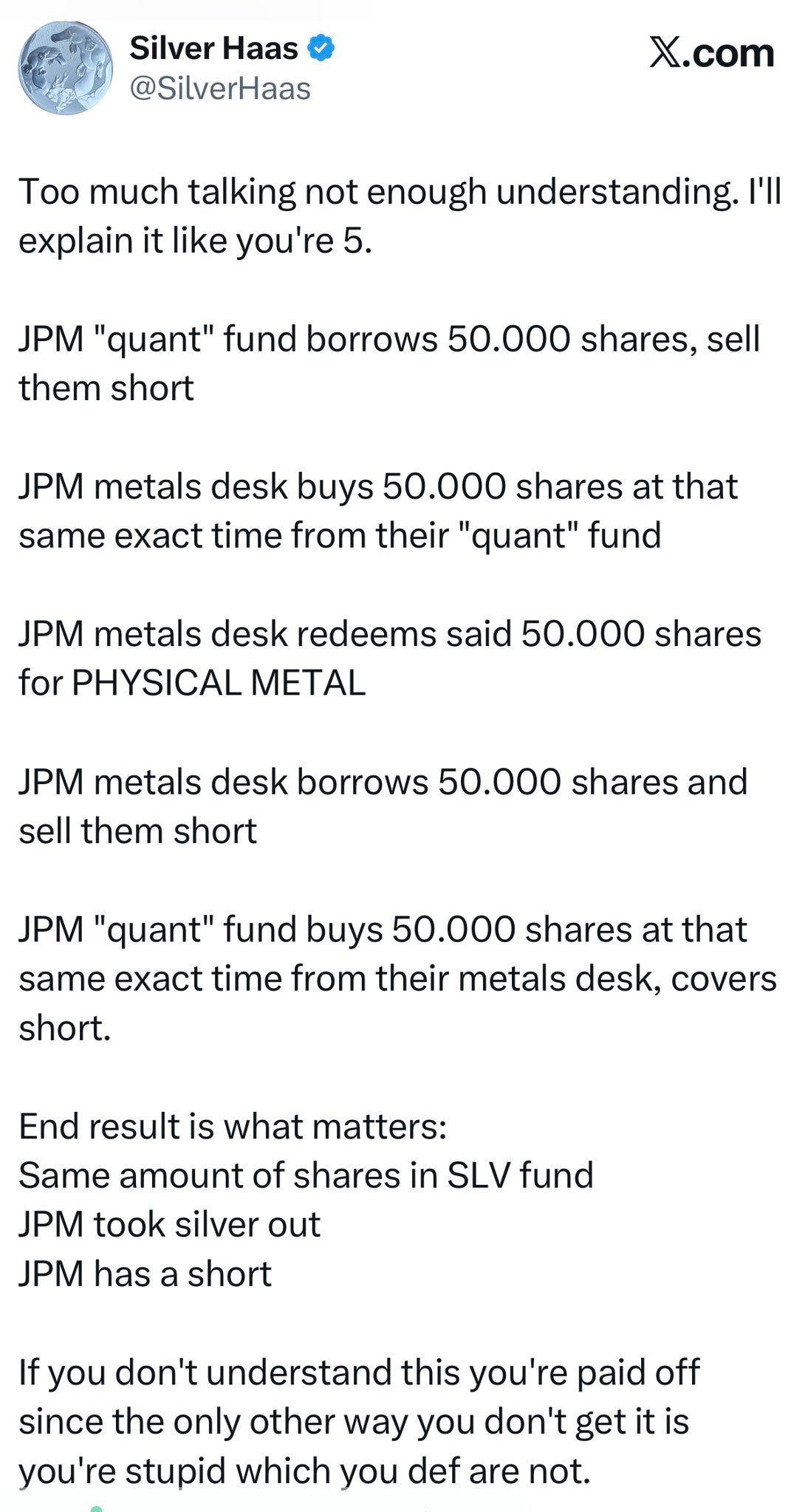
JPM’s quant desk borrows 50,000 shares and sells them short.
JPM’s metals desk buys those same shares.
Metals desk redeems them for physical silver.
Then borrows 50,000 shares again, sells them short, and repeats.End result:
Same number of ETF shares exist
JPM removes real metal from the vault
JPM is synthetically short silver
It’s a seamless paper loop… and it works across both SLV and PSLV.
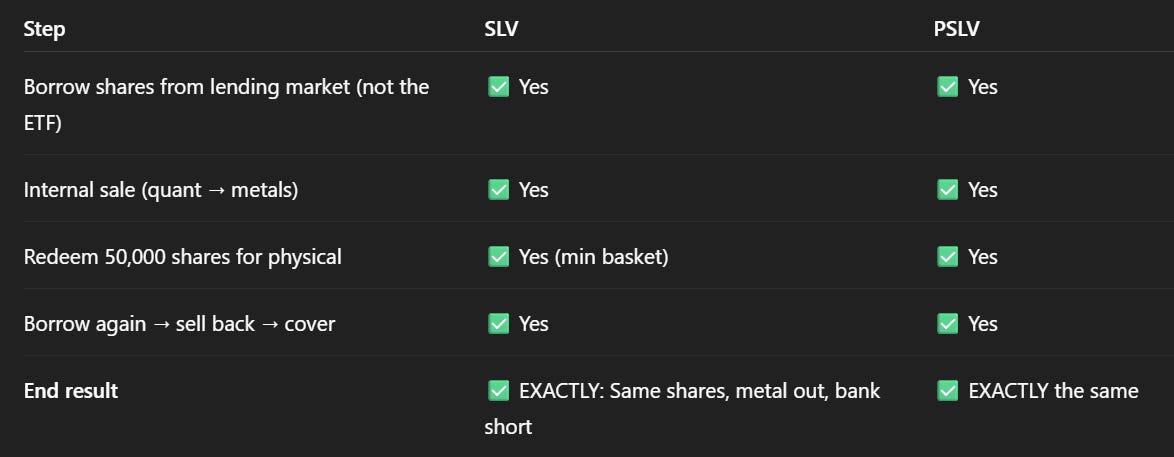
Real Mechanics (PSLV Mandate = The Fuel)
Ironically, PSLV’s transparency rules… designed to protect investors… also make it exploitable.
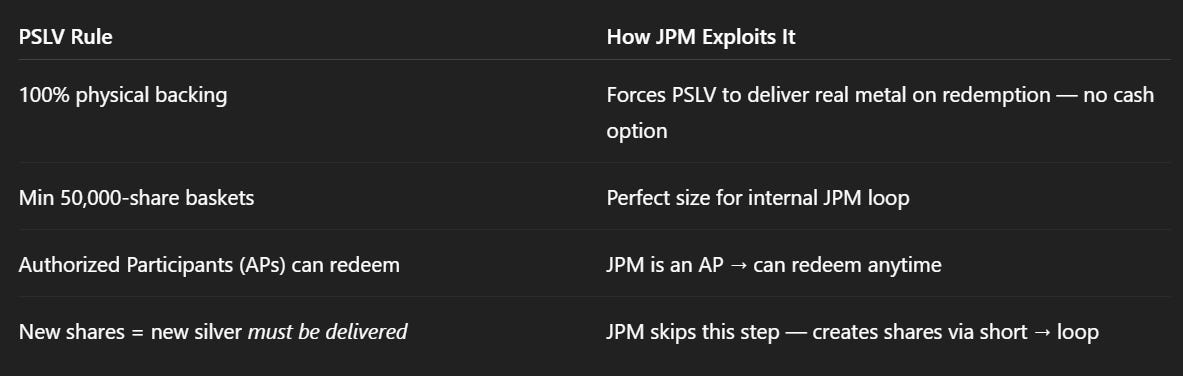
These rules are what make PSLV a useful drain for bullion banks. But here’s the twist: just because the loophole exists doesn’t mean it’s practical to use.
The “Short PSLV → Redeem Physical” Arbitrage Is Blocked
A recent analysis by Eric Yeung @Kingkong9888 nailed it: yes, APs can short SLV to redeem silver, but for PSLV it’s not practical or safe.
Here’s why:
1️⃣ No Creation = No Arbitrage Symmetry
In ETFs like SLV, APs can create and redeem shares, forming a perfect arbitrage loop.
In PSLV, no new shares can be created… only redemptions drain supply.
That means shorting PSLV doesn’t self-correct… it’s a one-way drain with rising pressure.
2️⃣ Redemption Is Costly & Logistical
Redeemed silver must be taken physically from the Ottawa Mint.
That’s ~700 pounds of metal per basket (10,000 oz).
APs must pay for assay, insurance, shipping, and storage.
Many banks simply lack the infrastructure or appetite for that hassle.
3️⃣ Risk of Getting “Stuck”
If an AP shorts PSLV and redeems, they receive silver… not shares.
To close their short, they must buy back PSLV shares in the open market.
But no new shares are being created… so if others are redeeming too, supply collapses and the price moons.
4️⃣ Premium Spiral Risk
Redemptions shrink the share float, creating scarcity.
If demand stays strong, the PSLV premium can explode… as it did in 2021, reaching +20%.
Any short seller caught in that feedback loop is obliterated.
Bottom line:
The banks may still short PSLV to suppress its growth and stop it from adding new bars…
But they’re not shorting PSLV as an arbitrage for physical redemption.
This matches PSLV’s historical data: metal outflows are slow, not cyclical.
Final Thoughts from the Rabbit Hole 🐇
Even PSLV, for all its transparency, still operates within the same paper pyramid.
Your “silver” might appear on a vault ledger… but that doesn’t make it your silver.
Most holders can’t redeem PSLV unless they control 400,000+ shares… roughly half a million dollars worth.
So even if the metal exists, you don’t own bullion; you own a promise of bullion.
Meanwhile, the COMEX and LBMA use that very promise to manipulate market prices… keeping the illusion alive while draining real supply.
That’s why physical shortages appear long before the spot price ever moves.
The PSLV story is really a warning about trust versus possession.
Even the “good” ETFs are built on the same framework of synthetic exposure and internal arbitrage.
The lesson is simple:
SLV is toilet paper.
PSLV is slightly nicer printer paper.
Only your own coins and bars are metal.
Wall Street’s greatest trick is making claims look like assets.
Whether it’s meme stocks or bullion, the pattern is the same… layers of promises stacked atop a shrinking base of reality.
When the world stops believing in the paper and starts stacking rock…
Rock beats paper… Every time.
Stay vigilant,
– Grey Rabbit
P.S. The great re-monetization of silver is only just beginning.
If this deep dive opened your eyes to how fragile the paper pyramid really is, the next step is understanding the how and when.
In my premium report, “Silver: Road Map to Freedom,” I break down the key technical levels, price targets, and catalysts driving what could be the most powerful bull market of our lifetimes.
This isn’t just another trade setup… it’s a strategic blueprint for the end of one monetary era and the birth of another.
👉 Upgrade to a paid subscription to get instant access to my weekly analysis and your copy of Silver: Road Map to Freedom.
Your poll forgot the option of At the bottom of lake after boating accident
Hello Mr Grey, in an effort to protect my modest lifestyle in retirement I own some PSLV, so I have skin in this game. I thought I owned the equivalent of a fixed amount of physical silver. Doesn't it say so here in the prospectus? Forgive my naïvité.
So I would like to understand the implications of what you say here. If JPM owns 50 thousand units worth of physical and is also short 50 thousand PSLV and the premium goes to 20%, who gets fried when they default? Who lent the units? Please tell me it's not Sprott?
There are probably questions I don't even know to ask, so please feel free to elaborate as to a 5 year old.
Thanks
Mark